How to Make Herbal Tinctures Without Alcohol (Glycerite Recipe)
Jul 31, 2026By Selima Iwilla Harleston Lust, Clinical Herbalist
Published: July 31, 2026 | Evidence reviewed: July 31, 2026
Quick Answer: A glycerite is a tincture made with vegetable glycerin instead of alcohol. Keep your finished liquid at least 60 percent glycerin (75 percent is better) and it will stay shelf stable for a year or more. Glycerin mainly pulls water-soluble plant compounds, so it is not a one-to-one swap for alcohol, but for kids, pregnancy, sobriety, or anyone who does not want the burn under the tongue, it is real medicine.
You have been wanting to make your own tincture. You just do not drink, or you are making this for your child, or you are pregnant, or you have tried the alcohol version and the taste alone makes you put the dropper down before you get the dose in. So you have been told alcohol is the gold standard and quietly decided tincture making is not for you.
It is still for you.
Glycerin is a thick, sweet, food grade liquid, and an herbal glycerite made with it is generally recognized as safe by the FDA when used according to good manufacturing practice, the same designation that covers it as a food ingredient. When you use it as your solvent instead of alcohol, that preparation is called a glycerite. It will not do everything alcohol does. But it will do something alcohol cannot: it will taste sweet enough that your child actually takes it, twice, without a fight.
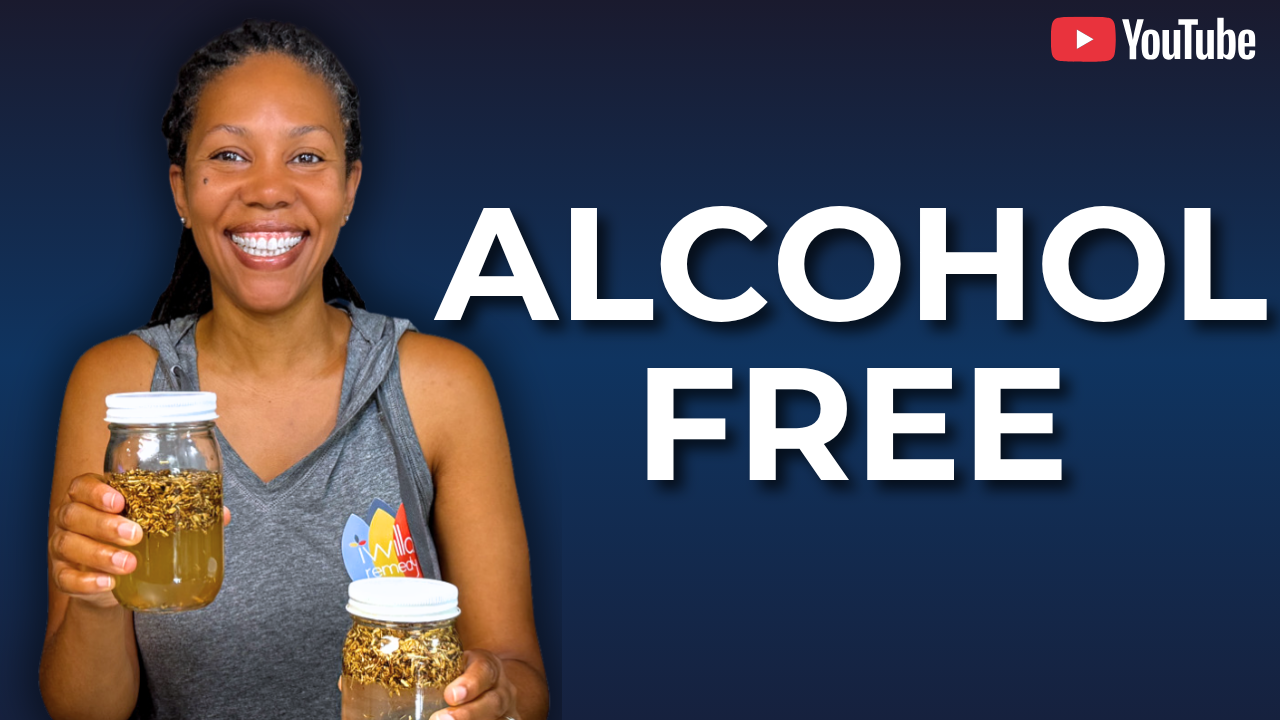
Below I walk through two ways to make one at home, the single ratio rule that decides whether your jar spoils or holds, and what changes when you are working with fresh plants instead of dried. I also show exactly what I do differently in my own kitchen and why. I demonstrate every step of this hands-on, so if you would rather watch me in real time, watch the full glycerite video here. This is video three in our tincture series. If you have not seen the alcohol folk method or the percolation method yet, this post stands on its own, but I will point back to them where it matters.
What is a glycerite, and how is it different from an alcohol tincture?
A glycerite is an herbal extract made with vegetable glycerin as the primary solvent, instead of the grain alcohol used in a folk method or percolation tincture. Glycerin is polar and mostly extracts water soluble constituents such as mucilage, tannins, and many flavonoids. Laboratory research on glycerol as a co-solvent has found it can pull certain water soluble plant compounds as effectively as, or in some cases more effectively than, ethanol, though that study looked at grape pomace polyphenols in a food science setting, not a full herbal materia medica, so treat it as supporting evidence for the mechanism rather than proof for every herb.
What glycerin does not do as well is pull the aromatic oils and resinous compounds in plants like lavender, peppermint, frankincense, and myrrh. Alcohol reaches those. Glycerin mostly does not. This is not glycerin failing at its job. It is glycerin having a different job. If you want to see how alcohol handles those same herbs, that is exactly what I cover in the folk method video and the percolation video earlier in this series.
When should I reach for glycerin instead of alcohol?
Reach for a glycerite when alcohol is not preferred or tolerated: sobriety, pregnancy, or medicine for a child. Reach for it when taste is the deciding factor, because the best remedy in the world does nothing if the person it is for will not swallow it. And reach for it when the compounds you are after are water soluble, since that is what glycerin pulls best.
If you are trying to extract resins, like the ones in myrrh, a glycerite is probably not your best choice. Matching the solvent to the plant and the person, not just following a recipe, is the whole discernment piece of herbalism.
How much glycerin do I need for a shelf stable glycerite?
Keep glycerin at a minimum of 60 percent of your total liquid, with 75 percent as the preferred target. This is the one rule that decides whether your jar holds or spoils.
Below 60 percent glycerin, your preparation is more likely to spoil, especially with fresh plant material. At 60 percent glycerin to 40 percent water, your glycerite is acceptable. At 75 percent glycerin to 25 percent water, you are in the preferred range. And 100 percent glycerin is stable too, just thick and sticky to pour.
Glycerin's ability to help preserve a preparation comes from a real, well documented mechanism: it lowers water activity, the amount of free water available for microbes to use. Good sanitation and cool, dark storage still matter. The ratio is not a substitute for either.
How do I make a simple glycerite with the folk method?
This is the easiest place to start, and it uses 100 percent glycerin.
Fill your jar about a quarter of the way with dried, cut or coarsely ground herb. Fill the rest of the way with glycerin, leaving about an inch of headspace at the top, and close the jar tightly.
Here is the twist that makes this version work: set the sealed jar in a hot water bath, kept under 150 degrees, for two to four hours. Glycerin is thick, and that gentle heat gives the plant's medicine the kinetic energy it needs to move into the liquid. Skip the heat and you skip a real part of the extraction.
When your time is up, strain while the glycerite is still warm, not hot, because glycerin thickens fast as it cools and becomes much harder to press through cheesecloth. Bottle it, label it, and store it somewhere cool and dark.
How does the weight to volume method give a more precise glycerite?
The weight to volume method is what I reach for when stability matters, because it lets me calculate the exact solvent percentage before I ever start pouring.
Say you are working with 30 grams of herb at a 1 to 5 ratio. That means 30 grams times 5, or 150 milliliters of total liquid. For a 60 percent glycerite, that is 90 milliliters of glycerin plus 60 milliliters of water. For a 75 percent glycerite, that is 112.5 milliliters of glycerin plus 37.5 milliliters of water. You are not eyeballing it. You are doing a little math, once, and then you know.
Here is a trick worth remembering: if your recipe calls for a glycerin and water blend, you can replace that water with a strong, fully cooled decoction of the same herb. Make an astragalus decoction, strain it well, let it cool completely, then use it in place of the plain water. The decoction replaces the water. It does not get added on top of it, so your glycerin percentage stays exactly where you calculated it, and you have pulled even more of that herb's water soluble medicine into the jar.
Some herbs, like licorice root, are bulky enough that a 1 to 5 ratio will not fully submerge them. When that happens, I move to a 1 to 10 ratio instead, so the herb stays fully covered. Any herb left exposed to air in the jar will oxidize, and eventually mold. A wider ratio with full, even extraction beats a stronger ratio where half the herb never touched the solvent.
In my own clinical practice, glycerin is actually the solvent I reach for the least. But when I do make a glycerite, I almost always use the weight to volume method, because it is the only way I can be certain my percentage is exactly where I need it to be. That certainty is what lets me trust the jar six months from now.
What changes when I use fresh herbs instead of dried?
Two things change. First, wilt your fresh herb before you start: lay it out on a paper towel on the counter for a few hours to release some surface moisture. Second, use 100 percent glycerin as your liquid, with no added water.
Fresh plant material is already carrying water inside it, and that water will thin your glycerin as extraction happens. If you start with a glycerin and water blend on fresh herb, the plant's own moisture can push your final percentage below that 60 percent stability line without you ever seeing it happen. Starting at full strength gives you room to land safely in range.
Pack the jar firmly with the wilted herb, not crushed, and add enough glycerin to fully cover the plant material, again leaving about an inch of headspace. Cap tightly and check that nothing is peeking above the liquid line.
When should this be checked with a doctor first?
Talk with your child's pediatrician, your herbalist, your midwife, or your own healthcare provider before starting any herbal preparation, glycerite included, if you are pregnant or breastfeeding, giving it to a child, managing a health condition, or taking prescribed medication. Many dietary and herbal supplements, including tinctures, have not been well studied in pregnancy or in children, and alcohol based tinctures specifically should be avoided during pregnancy, which is one more reason a glycerite is often the right choice in that season. The National Center for Complementary and Integrative Health also recommends telling every provider you see about every herbal product you use, since herbs can interact with medications in ways that are easy to miss. If a symptom is severe, sudden, or not improving, that is always a reason to call your provider, not a reason to keep adjusting the jar.
What do I actually need to make one at home?
Nothing fancy. A clean glass jar, food grade vegetable glycerin, your dried or fresh herb, a kitchen scale if you are using the weight to volume method, and something to strain through.
Some of the links below are affiliate links, which means I may earn a small commission if you buy, at no extra cost to you. If you want to see the everyday tools I actually reach for, jars, a kitchen scale, and the rest, they are on my curated tools list. You do not need any of it to start. Start with what is already in your kitchen.
Where does a glycerite land on shelf life, and how should I store it?
Store your glycerite in a cool, dark place away from direct sunlight, and label it fully: the herb, the method, the glycerin percentage, the ratio, and the date. There is nothing worse than finding a beautiful jar six months from now with no memory of what is inside it or how strong it is.
Exactly how long a glycerite keeps depends on the concentration, the herb, and how it is stored, which is exactly why that percentage on the label matters as much as the herb name does.
The turn
An alcohol-free tincture is not a lesser version of herbal medicine. It is the right choice for some herbs, some people, and some seasons of life. You do not need to apologize for reaching for the sweet jar instead of the strong one. You just need to know the ratio, and now you do.
There is a healer in your bloodline. There is a healer in your home, it is you, and you do not need alcohol to prove it. You can make real medicine for your whole family, and they will actually take it, because it tastes like something they want to swallow twice.
If stepping fully into that role, being the one your household turns to for coughs, cramps, and the 2am fevers, is the direction you are moving in, that is the whole heart of what I teach inside Family Farmacy. It is where we go deeper into making remedies your household can rely on, body system by body system, at your own pace. If you are just looking for one recipe for one jar, this post already gave you that. But if you want to stop Googling and start knowing, Family Farmacy is where we walk that road together.
Frequently Asked Questions
Can I use any glycerin, or does it need to be food grade? Use food grade vegetable glycerin, not the glycerin sold for soap making or industrial use. Food grade glycerin is what makes the finished preparation safe to take internally.
Is a glycerite as strong as an alcohol tincture? Strength depends on more than the solvent. It depends on whether the herb is fully extracted, whether the ratio fits the plant, and whether the preparation is stable, not only on how much herb went into the jar. A well made glycerite, even at a wider ratio, can be excellent medicine, though it will not carry the same aromatic and resinous compounds that alcohol reaches.
Do I have to use heat when making a glycerite? For the folk method, yes. Glycerin is thick, and the gentle warmth in a water bath under 150 degrees gives the extraction the energy it needs. Skipping the heat generally means an incomplete extraction.
Can I replace the water in a glycerin and water blend with tea instead of plain water? Yes, and it is a genuinely useful trick. Use a strong, fully cooled decoction of the same herb in place of the water, not in addition to it, so your final glycerin percentage does not change.
Is a glycerite safe for children? Many parents and caregivers reach for glycerites specifically because a child will take them without a fight, and the alcohol-free format matters for that age group. Still, talk with your child's pediatrician before starting any herbal preparation, and start low and go slow.
Sources and Further Reading
- 21 CFR 182.1320, Glycerin. U.S. Food and Drug Administration, Code of Federal Regulations. Confirms glycerin's status as Generally Recognized As Safe for food use under good manufacturing practice.
- Glycerol as Alternative Co-Solvent for Water Extraction of Polyphenols from Carmenere Pomace. PMC, 2020. Laboratory food-science study on glycerol's extraction performance compared with ethanol; supports the mechanism, not a claim about specific medicinal herbs.
- Molecular Basis of Water Activity in Glycerol-Water Mixtures. PMC. Explains the water-activity mechanism behind glycerin's role in preservation.
- Herbal Products. MotherToBaby Fact Sheets, Organization of Teratology Information Specialists, NCBI Bookshelf, 2025. Notes that tinctures can contain alcohol, that alcohol should be avoided in pregnancy, and that most herbal products have not been well studied in pregnancy.
- Using Dietary Supplements Wisely. National Center for Complementary and Integrative Health. General safety guidance, including telling every healthcare provider about herbal product use.
This article is for educational purposes only. It is not medical advice, and it is not a substitute for care from your doctor, midwife, pharmacist, or other qualified provider. Herbs can interact with medications and are not right for every body or every circumstance. Talk with your healthcare provider before starting any herb, especially if you are pregnant or breastfeeding, giving herbs to a child, managing a health condition, or taking prescribed medication. If you are experiencing a medical emergency, call emergency services.